Saturday, 19 March 2011

Different support

Grove Ferry / Stodmarsh

I left home this morning at 7.30 for Grove, arriving in heavy mist just after 8 (despite it being perfectly clear at Chartham). I walked down to the Feast hide in anticipation of the sun breaking through quickly. Cettis were signing and a pair of reed bunting went about their daily business in reed bed. There was not much other activity but I decided to stay there until visibility and light levels improved, which was a full two hours later. In the meantime I took a few shots of a greylag that was on the raft. The light was very 'white' and I was compensating a full +2 1/3 stops to get good exposure - now that's shooting to the right!!


In the past I've used a Wimberley tripod head for support and although it works really well it's quite a lot to lug around in addition to the tripod. I used a monopod today as I was planning to do a fair bit of walking. This turned out OK and I will probably do it again when I want to be more mobile - particularly as image quality was not adversely affected.

Once the light improved, I cut over to the Stour and walked down towards Stodmarsh. The same rain that had drenched me on Canterbury golf course yesterday had left the walkways very treacherous. I slipped over once but somehow managed to keep my equipment from landing in the mud - more by luck that judgement.


There were plenty of teal and lapwing on the meadows and robin, chaffinch and various tits in the bushes lining the river but no sign of bullfinch or yellowhammer, which was disappointing. By now there were marsh harrier over the reeds and a sparrowhawk circled over too.

It was fairly quiet in the wood so I continued to walk up towards the Marsh hide, taking a shot of some nicely coloured catkins on the way. There was a black-tailed godwit in with the lapwing from the marsh hide - not something I've seen at the reserve too often.


Just as I got to the end of the cleared out area I spotted a willow warbler *** in one of the willows that has fallen over. I hung around photographing it for about half an hour and managed a few good shots despite it  being highly active and often in dense parts of the tree.

*** On closer inspection probably a chiffchaff - could someone confirm? I usually rely on song to differentiate...


I dropped into the Feast hide again on the way back but it was just as quiet as earlier. One bonus was a merlin that flashed across the top of the reedbed, heading towards the orchard.

Waxwing at Fort Belvedere (Berks)


Despite all the waxwings that have been about I've not seen one this winter (I know, I need to get out more!). However, Martin Washford had a flock of over 50 individuals where he was working at Fort Belvedere and managed to get a shot of them drinking from the edge of the frozen lake early one morning last week.


One of the smallest spring flowers, that of the hazel.

Hazel flower

Friday, 11 March 2011

Broken promises and dipping on dipper

The Lakes

Just back from an excellent few days in Ambleside, walking in the fells, eating and drinking too much - the ususal stuff. I vowed not to do any bird photography whilst away but there was just enough room in the boot for my long lens and all the other luggage would have just jangled around wouldn't it!

My best photo opportunity came when I least expected it. The river Rothsay runs through the churchyard at Grassmere and was host to not only the ubiquitous mallard, but three pairs of goosander were working their way downstream. I only had my 24-105mm lens on so just a record shot but nice to see them anyway.


Later that afternoon we crossed Stock Ghyll and I heard a dipper that subsequently landed on a rock near the foot bridge. Making a mental note I slipped out the next afternoon and my hopes were raised as two bird photographers were installed by the bridge. I parked the car and walked up asking "any sign of the dipper"? "Oh yes, been in and out for the last two hours" came the reply. I hunkered down excitedly beside the bridge for an hour and half but when my shutter speed hit 1/125th at f/4 ISO1600 I decided to call it a day.

Friday, 4 March 2011

Redheads galore

I arrived at the car park by the Arc pit at Dungeness just as Mick two-converters Sinden was getting out of his car vehicle. We ambled up to the hide together, chatting, arriving around 13.45h. The wind was head-on into the hide but at least the light was promising (in fact it improved as time went on).


Two female and one male goldeneye were in the area all afternoon giving plenty of photo opportunities..

[Click any of the images to view at 1024px]


There were 8 readhead smew that came and went during the couple of hours I was there. A lone drake was over the far side, roosting in with the raft of pochard. It drifted over towards the hide but flew off towards the screen and shortly after that disappeared completely. The drake goldeneye was obliging enough that maybe the smew was too much to ask for!


The light continued to improve and the wind abated, making focusing easier as the ducks were not bobbing up and down so much.

The drake goldeneye was still strutting his stuff.


Oh, you beauty!
Tufted duck are often overlooked but, if their head is at just the right angle, one can pick up superb green hues in their plumage.


As I walked back to the car I heard a cetti's warbler singing in the scrub. A reminder that Spring is just around the corner. The diving ducks will soon be gone and a fresh set of migrants will be hitting our shores once again - BRING IT ON!!

I'm off to the Lake District next week for a last taste of Winter. Probably little nature photography but my camera will be at my side all week.

Monday, 28 February 2011

Billy-no-mates

I've been blogging for a couple of months now and not picked up too many followers so I was very please to see Steve Ashton on board. Steve's is one of the few sites I follow, along with John Devries and Nigel Blake.

I don't feel like I'm posting stuff into a vacuum quite so much now and my paranoia alert status has dropped from 'Red' to 'Amber'...

Death by 'Lichen'

Preamble

You can always tell when I've not been out with may camera much when I throw in a technical tip or spout random stuff! What's my excuse? Too busy doing other things and, when I'm free it's been raining hard. Yesterday was a great example, I had arranged a game of golf at Boughton with a good friend of mine and it was a beautiful day.

Death by 'Lichen'

I entered four images into the recent Ashford Photographic Society Natural History competition. I won the projected digital images section with my White-tailed Eagle (taken on Loch Na Kael last June) but the overall winner was judged to be a slide of a piece of lichen on a rock. Congratulations to Neville Marsh for winning the trophy - I think he was as surprised as everyone else (I don't think mine was the best image there either so no hard feelings!) There's always next year.


RHS Wisley

On Saturday I pottered over to Wisley with my wife to meet a friend of ours. I took the camera of course (you know how women like to chatter...) as I believe that just shooting nature all the time is a bit one-dimensional. Variety is good and it helps to make one a more complete photographer. I did try some fill-in flash in the butterfly house - this worked out really well. I've posted the images on the APS Facebook page. Hope I can put it into practice effectively in the wild.

I've only got eight more weeks to go at work now so looking forward to my spring career break to get out with my camera even more before I need to think about bringing in some money...

Sunday, 13 February 2011

Ugly Duckling to Swan Lake

Ugly Duckling

Saturday afternoon brought the promise of some sunshine - remember that? I managed to escape the household chores and headed over to Oare Marshes, somewhere I have not been for a while but fancied trying to get some flight shots from the roadway. A north-west wind was in my favour as the birds taking off from the east scrape would be head-on. It was that flat, grey light that has blighted us so much of the year that greeted me - it was a real 'ugly duckling' of a day!

Huge flocks of lapwing were on the move over Sheppey with a ring-tail and peregrine making brief appearances as the grazing Highland Cattle gave birders in the east hide a close encounter.

There were plenty of wigeon, teal and pintail around - the latter keeping out of range.
Wigeon
Drake teal
A flock of 19 mute swans glided onto the east flood as the tide came up, coinciding with the odd break in the clouds.

What a difference a stop makes!

Gradually the light improved and, by around 3.30pm, it was looking very hopeful. Hundreds of golden plover were making their way off the Swale onto the flood to roost up.
Golden plover in improving light
Wigeon were constantly on the move
Swan Lake

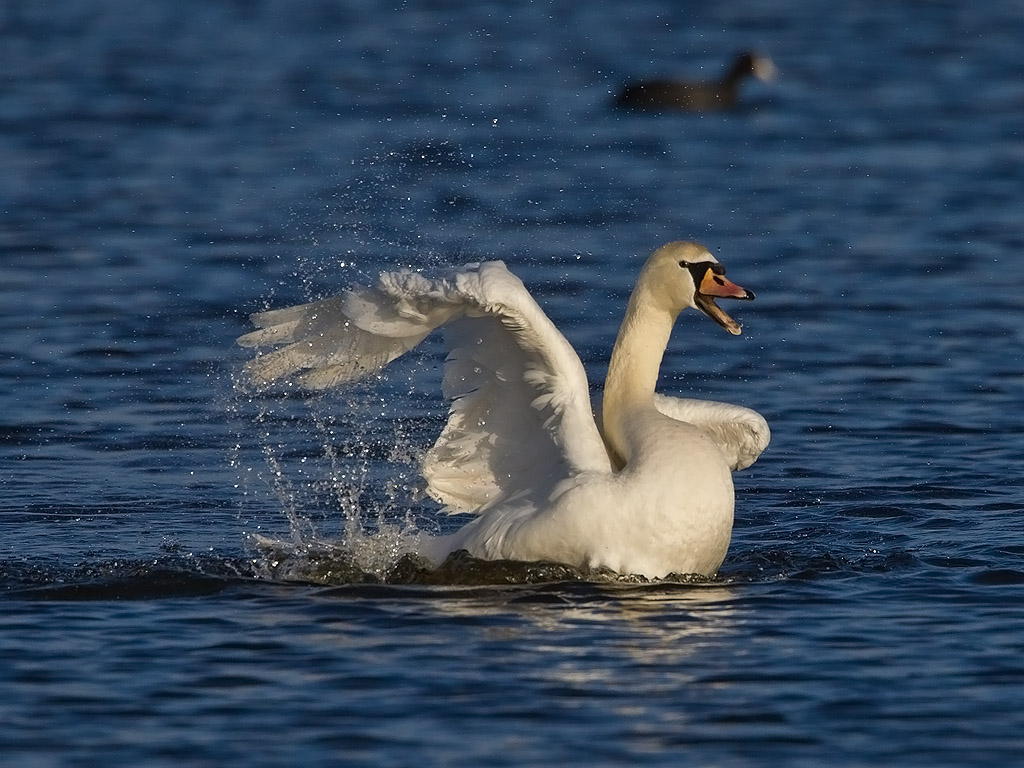
I guess the swans had been on the estuary for most of the day and were keen to wash the saline remnants from their plumage and preen up. What happened next was amazing - I was witness to a command performance of Swan Lake - too many images to load but here are some of the best.

[On arrival I was getting a shutter speed of 1/640th at ISO1250, by now I was at 1/6000th at ISO800. Very contrasty light so needed to keep an eye on exposure compensation and histogram so as not to burn out the white highlights]


I've titled this image 'Angel' in memory of John Devenport, fellow photographer and member of Ashford Photographic Society who died suddenly, aged just 55, last Wednesday. A finer chap you could not wish to meet. He will be sadly missed by all that knew him and my thoughts and prayers go out to his wife Katrina and son Oliver.


It must be love!


In my photography I'm not too worried about chasing rarities - a good image of a common bird is far more pleasing to me than an average image of a rare bird. I strive to get images of my subjects actually doing things and pay particular attention to composition - note how there is separation between head and wings on the single-swan shots - a slight overlap kills the impact.

The supporting cast

Enter stage left - greylag geese
At this point, I'd like to say thank you to Gabby and Brian for the most welcome (ever) mug of freshly brewed coffee. Brian seemed to be more interested in keeping up with the rugby until the barn owl took centre stage for a cameo appearance.

Gabby - good luck for the London Marathon next month. Keep fit and enjoy it!


It was great to meet up with Nige and his wife (sorry, did not get your name...) and Steve Mackay at the reserve. I hope to see you again soon!

Time to go home . . .

Tuesday, 8 February 2011

It's tight at the top

Ashford Photographic Society

We have just held our third round (of four) of the projected digital images competition and my golden plover image managed a third place with 19 points (out of 20). To see all the winning images visit the website .

It's the big one for me on Feb 18th - the natural history competition. I've entered two prints and two digital images. We have some very good wildlife photographers at the club and the competition is always hotly contested. I won it two year's ago but I'm not holding my breath.

Work gets in the way

I resigned from my job a fortnight ago and have three months notice to work out. I visited one of the groups that I have done some developments for today to start some handover/documentation. Trust me to pick a perfect day weather wise to be stuck in the office - like everyone else I'm fed up with all this grey weather. Anyway, the good news is that spring is on the way, the bad news is that I need to start looking for another job!

Tuesday, 1 February 2011

'Wasp-proof bird' video

Honey Buzzard raiding next

Honey Buzzard numbers are increasing in the UK, with an estimated 70 pairs nesting, mainly in East Midlands/Norfolk and Central/Southern England. They are summer visitors from Africa and their diet is predominantly the larvae of bees and wasps.

Whilst on holiday in France a couple of years ago, Martin Washford managed to film one raiding a nest on a road side verge.


Tuesday, 25 January 2011

Back to the drawing board

My attempts to capture birds in flight at the woods this morning were not entirely successful (understatement of the week). Even with a shutter speed of 1/1250th I could not freeze the wing movements of the nuthatch. With the ISO already at 1600 and shooting at f/8 to get enough depth of field I could have done with a bit more light - two stops would have been nice. The IR remote release works really well so it was not all wasted time and I'm a step further up the learning curve.

The usual suspects were on the scene. 

Managed to capture with a nice clean background


One has to admire the ingenuity of these guys as they prize nuts and seeds from the feeders
I visited my friend Neil on the Romney Marsh this afternoon and took a walk along the Royal Military Canal at West Hythe on the way - most pleasant.

I was further cheered to hear on the radio on the way home that Andy Gray has been sacked by Sky Sports - RESULT (After all is said and done, he is to punditry what Phil Collins is to music). Let's hope that 'wednap' junior doesn't take over . . .

Thursday, 20 January 2011

If you go down to the woods today . . .

I'm getting to know the wood a bit better now. The feeders are doing their job and there are lots of opportunities to shoot 'portrait' type of shots of common woodland birds.

The challenge I have set myself is to do some birds in flight (BIF). To this end I have invested in an IR remote release for my camera. I've tested this out and it is fairly simple to use - of course the challenge is to get the birds to fly past the end of the lens!! I've got a few ideas on how to achieve this, in the meantime, here are a few shots I took down there earlier.

Great tit checking the coast is clear before raiding the feeder
This nuthatch is a regular visitor to the feeder in a very 'smash-and-grab' style
It did stay still enough to get a couple of shots
An opportunist squirrel came onto the scene too.

Just managed to frame him without cutting off his toes

Monday, 17 January 2011

Technical tip #2 - Composition

After a week of poor weather and a dose of man 'flu there are no new images from me this week. Instead I thought I would share a few thoughts on composition.

The importance of composition

As photographers we want to create images that not only please us but please other people - be it a 'thumbs up' on a web site gallery, acceptance for publication or even someone purchasing one of our photographs. Just to be clear, composition is all about getting it right in camera and, whilst I'm competent enough in Photoshop to perform any number of manipulations I'd much rather not have the bother. Image processing in Photoshop for me is all about enhancing my images rather than fixing them. I've got to a point now where I rarely do any more that levels (possibly curves), cropping and a hint of sharpening - life's too short to be spending large portions of it at the computer.

Composition

Composition is as important in photography as exposure and focusing - get all three right and you'll have great images - and it starts before we even leave the house. Below is a kind of mental checklist that I use when planning a bird photography trip.

  • What is my target species and/or location?
  • What is the wind speed and direction? Birds will always take off into the wind and prefer to feed facing into the wind. For example, if the wind is in my face and I'm are trying to photograph waders I may struggle to get anything other than rear-end shots
  • What is the best time of day to go in terms of lighting? Sitting in the Scott hide at Dungeness RSPB first thing in the morning will be straight into the sun, with reflections off the water to contend with too
  • What are the tide times? If I go to a pool near the coast whilst the tide is fully out will the birds be out on the mudflats too? Just before and after high tide will be good times if I want to capture birds in flight as they move from the mud flats to fresh water pools
  • If I am photographing birds in a semi-controlled environment (e.g. back garden) have I done the best to arrange any feeders/perches in their optimal configuration/orientation?
One of the key elements of composition that is often ignored when starting out is backgrounds. There may be times when we want to show the animal in its natural environment or we may wish to fully isolate it as a portrait with a totally diffuse background - or maybe somewhere in between.

In its natural environment, surrounded by grasses and semi-diffuse buttercups, the hare, side on munching on grass [Elmley RSPB taken from car window]
Red-backed shrike (juv) with fully diffuse background  - a portrait of the species. Note the complementary colour of the background too (natural shingle). [Dungeness RSPB]
Viewpoint

With the effective depth of field being determined by the lens focal length, aperture and focal distance, we have some level of control as to the degree of focus we have in our backgrounds. We often shoot at wide apertures, say f/4 to f/8 which help to isolate our subject but if we can increase the distance between our subject and the background we can take it further out of focus and leave it more diffuse. This is typically achieved by taking a lower position with your camera as shown in the diagram below.

By shooting from a lower standpoint - camera height [2] - the background will be further from the subject and will be further out of focus and hence appear more diffuse in the image
This american red squirrel photographed by Martin Washford is a excellent example of taking a low standpoint. The background is beautifully diffuse and also, just as importantly, we feel that we are not 'looking down' at the subject but are at its level and in its world.
Getting at eye level with this fox gives a real empathy with the subject [photographed by Martin Washford on a site he was landscaping]
Of course, if you are in a hide or shooting from the car window then you may not be able to get any lower. This is why I prefer not to photography from hides, instead, taking my chances crouching behind bushes or prone on the ground with a beanbag as support.

Ideally you should avoid bright highlights in your image backgrounds as these are very distracting - they should be natural and complementary. Often by moving a few metres from one side or the other it is possible to take a bright reflection out of the background and replace it with a dark, complementary one.


By ensuring a small bush was behind this reed bunting there are no distracting highlights [Oare Marshes]
Lighting

Typically we shoot with the sun at our backs or from the side but there are occasions when backlit subjects, with the correct exposure, can give something a little different.

Female kestrel with low light from behind and to the right gives a nice fringing to the feathers below the beak [Oare Marshes]